
In 1984, Quantel started development of a photo resolution version of the Paintbox for print applications, adding extra digital stores to a video Paintbox to increase the working file size. First revealed at the IPEX print industry exhibition at the NEC in Birmingham in late 1984, the prototype caused so much excitement according to
journalist Simon Eccles, that a crowd blocked the aisles. There were other more basic photo retouching options in the repro industry at that time from companies such as Scitex and Crosfield but they were instantly made to look outdated by the real-time artist-friendly GPB. The enthusiastic reception was enough to convince
Quantel there was a potential market for a photo quality Paintbox and around a year later, a $400,000 commercial version was launched with a resolution of 2048 x 2560 pixels, displayed on the incredible new Sony HDVS monitor.

The Paintbox however had two major drawbacks, both of which were solved with one solution. Being video monitor based technology, the image on every Paintbox was built up of red, green and blue pixels, whereas the repro industry built up each printed image using cyan, magenta, yellow and black plates.
With no black, the RGB Paintbox was incompatible and, because Quantel ran its own proprietary software, the machine and its 1" nine track digital output tapes couldn't be connected to any existing printing tech.
The easiest solution was to output the file onto large format slide film, which then could be scanned into any other repro device, or converted into CMYK in the same way as any conventional photographic slide was at that time.

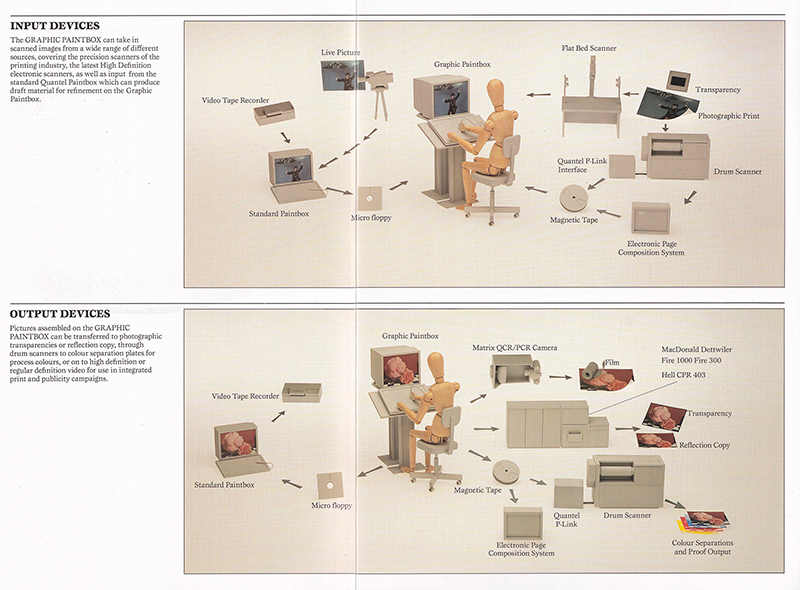
After adding on the cost of a HDVS monitor, drum scanner, iris printer, output film recorder, plus other peripherals and the artist to use it, a complete GPB setup could add up to a million dollars. But charged to clients at $500 per hour and working 24/7, those who took the risk did often reap the financial rewards.
The GPB was never going to be a consumer product, which is one of the reasons why few are aware of the machine and believe that photo manipulation really began with Photoshop 1.0 - revealed 6 years after the GPB.
The GPB was updated over the years, as can be seen in brochures in the archive section of this website, selling well to specialist digital retouching companies such as Electric Paint in Los Angeles, Color Wheel in NY (who bought 14!), Printed Picture Company in London, Centro in Hong Kong and Vienna Paint https://viennapaint.com/ in Austria, who published two coffee table books which showed off the GPBs capabilities.
There was even a large artist's association called the Quantel GPB Users Group that met around the world and famous artists including David Hockney, Peter Blake and Keith Haring all jumped at the chance to use one. Though it was highly unlikely you would come across an actual GPB, it is as highly unlikely that you have not seen
work that was created on it. From magazine covers, print ads and billboards, movie posters and record covers, GPB images were everywhere...

Here you can watch Queen's Miracle album cover design by Richard Gray being put together on the GPB...
One of the most famous images created on the GPB was Queens Miracle album cover design by Richard Gray

Such was the popularity of the video Paintbox and GPB, before Photoshopped became a verb, the phrase people used to refer to digitally manipulated images was Paintboxed, as in this book from 1994.
The creator of the GPB International Exhibition for Quantel talks us through how his GPB2 worked after switching it on for the first time in 10 years...
With cheap hardware and software such as Photoshop, the demise of the GPB was inevitable, especially as Quantel's bosses had no interest in becoming a global monopoly by firing the loyal factory workers, just to sell Paintbox software CD's in a box.
The Face magazine even described the GPB as the most powerful influence on the fashion industry in 1995, prompting us to make this video charting the history of this largely forgotten legend...
Quantel finally addressed the CMYK issue in the 90's and enabled the GPB to link to Apple Macs, enabling some GPB artists whole loved the UI so much to keep using it for as long as they could. In 1996, Quantel mistakenly decided they's had enough of Adobe's aggressive, illegal and monopolistic business practices and sued them for Paintbox patent infringement.
This was one of only three times, Quantel ever sued and, no matter the facts, it was optimistic to think a British company could win a case in a Delaware court where Adobe was based, facing top lawyers provided by free by Apple and a string of American witnesses who didn't say Adobe hadn't copied the Paintbox's features but pointed out that colleges had experimented with the same ideas before Quantel, therefore nullifying the Patents.
Bear in mind that Quantel predated Apple and the Paintbox was launched before Adobe even existed.
The time and money wasted on the lawsuit was a very badly timed distraction for Quantel bosses at a time when both the video post-production and digital photo manipulation sector was quickly transforming.
Some GPB artists didn't jump off the rapidly sinking GPB ship however, such as the late Reinhard Ottenlinger, who famously assembled the photographs for Andreas Gursky, and used his twenty year old GPB2 daily, until it finally stopped working in 2020.
I also know of an advertisement created on a GPB in 2025, so the legend does still live on!